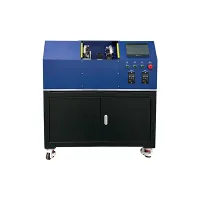
Core Process Flow of Dry Electrode Manufacturing for Lithium-ion Batteries
1. Dry Mixing Process
The active material, conductive agent, and binder are fed into a high-speed mixer and uniformly blended. During mixing, the binder particles undergo fibrillation, forming a three-dimensional network structure that enables effective binding.
Key Process Controls:
Precise control of parameters such as rotational speed, temperature, shear force, and mixing time is critical to achieving optimal fibrillation and dispersion.
MRBEST Equipment Advantages:
* Customizable rotation directions of the mixing blades and dispersing discs to meet various powder fibrillation requirements
* Material residue rate < 0.5%, ensuring high material utilization and reduced waste

2. Hot Press Film Formation
A critical process in dry electrode manufacturing, hot press film formation uses temperature-controlled roller sets to compact dry powder particles under specific pressure and temperature, forming a uniform and dense electrode layer.
Key Process Controls:
Precise control of roller temperature, applied pressure, rolling speed, and gap spacing is essential to achieving the desired thickness and electrode density.
MRBEST Equipment Advantages:
* Highly accurate temperature regulation
* Roller temperature difference maintained within ±1°C, ensuring consistent film quality and uniformity

3. Cutting
After film formation, excess material, irregular edges, or areas with incomplete coating on both sides of the dry electrode sheet are precisely cut off to obtain clean edges that meet specification requirements.
Key Process Controls:
Powder layer edge detection
Stable tension control
Fine blade adjustment
Electrostatic discharge (ESD) control
MRBEST Equipment Advantages:
* Precision adjustment module allows fine-tuning of blade spacing and angles
* Automatic negative-pressure collection of cutting debris, ensuring clean edges with no powder detachment

4. Single-Side Film Formation
The electrode film is laminated onto one side of the current collector (aluminum foil or copper foil) through hot pressing. This process is suitable for lab-scale production, small-batch multi-model manufacturing, and electrodes requiring asymmetric designs.
Key Process Controls:
Precise temperature control during hot pressing
Stable pressure regulation
Uniform calendering to ensure consistent bonding quality
MRBEST Equipment Advantages:
* Advanced servo control system enables online roller gap adjustment with ±1 μm accuracy
* Highly accurate temperature control, with roller temperature difference maintained within ±1°C

5. Double-Side Film Formation
The electrode films are laminated onto both sides of the current collector (aluminum or copper foil) simultaneously through hot pressing, forming a symmetrical "electrode film – current collector – electrode film" structure.
Key Process Controls:
* Precise temperature control during hot pressing
* Stable pressure application
* Uniform calendering to ensure consistent dual-side bonding
MRBEST Equipment Advantages:
* High-precision process control enables one-step double-side lamination
* Increased production efficiency with a maximum film formation speed of 50 m/min
* Supports automatic unwinding and rewinding